
Maratha Mandal’s Nathajirao G. Halgekar
Institute of Dental Sciences & Research Centre, Belagavi

- Home
- Management
- Departments
- Academics
- Admissions
- All Events
- IQAC
- NIRF
- NDC
- NABH
- Committees
- Dental Education Unit
- CDE Cell
- Infection Control Committe
- Anti ragging Committee
- Disciplinary Committee
- Gender Sensitivity Cell
- Student Coordination / Grievance committee
- Cultural Committee
- Sports Committee
- Timetable Committee
- Examination Committee
- Ethical and Research Committee
- Fire Safety and Disaster -Management Committee
- Human Rights Committee
- Research
- Resource
- Extension Activity
- Contact Us
What Is Oral Pathology? A Beginner’s Guide for Students
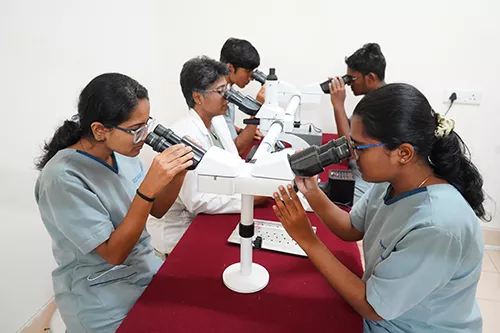
Oral pathology forms the scientific foundation for understanding diseases affecting the oral and maxillofacial region, making it one of the most critical subjects in dental education despite often being introduced at an early academic stage. For beginners, oral pathology bridges basic medical science and clinical dentistry by helping students recognise how normal oral tissues change under disease conditions and how these changes influence diagnosis, treatment planning, and long-term patient care.
Understanding Oral Pathology in Dental Education
Oral pathology focuses on the study of diseases affecting the oral cavity, jaws, salivary glands, and related structures, combining clinical observation with microscopic and laboratory analysis. Within structured dental education, this subject trains students to identify abnormalities, understand disease progression, and correlate clinical findings with histological evidence. Institutions such as Maratha Mandal Dental College integrate oral pathology early in the academic journey to help dental students develop diagnostic thinking alongside theoretical learning.
Why Oral Pathology Matters for Dental Students
Oral pathology offers essential insight for new dental students, explaining the appearance of lesions, the progression of infections, and how systemic diseases can present within the mouth. This subject sharpens observation skills and strengthens analytical thinking, both of which are essential for safe clinical practice. A well-established dental college in Belagavi emphasises oral pathology as a core discipline because accurate diagnosis forms the basis of effective and ethical treatment.
Linking Theory With Clinical Training
Oral pathology does not remain confined to textbooks, as its relevance becomes increasingly clear during clinical training, where students encounter real patient cases with complex presentations. Understanding pathological changes allows students to interpret symptoms, radiographic findings, and tissue responses more confidently. Strong integration of oral pathology within hands-on dental training ensures that students transition into clinics with a deeper understanding of disease rather than surface-level recognition.
Role of Dental Laboratories in Oral Pathology
Laboratory work plays a vital role in oral pathology by enabling microscopic examination, slide preparation, and tissue analysis, which help confirm clinical diagnoses. Exposure to dental laboratories allows students to understand how biopsy samples are processed and how laboratory findings support clinical decisions. This experience strengthens pre-clinical and clinical exposure, reinforcing the connection between observation and scientific evidence.
Oral Pathology and Modern Dentistry
In modern dentistry, oral pathology supports early detection of conditions such as oral cancers, precancerous lesions, infections, and developmental abnormalities, contributing directly to improved patient outcomes. Digital microscopy and advanced diagnostic tools have further enhanced accuracy, making pathology an evolving discipline rather than a static academic subject. Institutions offering quality dental education in Belagavi ensure that students are familiar with both traditional pathology concepts and emerging diagnostic approaches.
Ethical Practice and Patient-Centered Care
A strong foundation in oral pathology supports ethical dental practice by reducing misdiagnosis and unnecessary procedures while improving patient communication and trust. Understanding disease processes allows students to explain conditions clearly and recommend appropriate treatment options, aligning clinical decisions with patient-centered dental care. Such ethical awareness is a key expectation placed on future dental professionals.
Preparing Future-Ready Dentists Through Oral Pathology
A strong foundation in oral pathology supports ethical dental practice by reducing misdiagnosis and unnecessary procedures while improving patient communication and trust. Understanding disease processes allows students to explain conditions clearly and recommend appropriate treatment options, aligning clinical decisions with patient-centered dental care. Such ethical awareness is a key expectation placed on future dental professionals.